

Eight months ago I installed the LYNK PROFESSIONAL 4-tier steel spice drawer organizer in a client's kitchen in suburban Denver, a 1990s ranch house with narrow drawers and a spice collection that had been living in a cabinet for twelve years. The client, Marcela, 44, had three teenagers and cooked dinner from scratch at least five nights a week. Her spice drawer was a running joke in the family: digging for cumin took longer than chopping an onion. I had tried two different acrylic tiered inserts in her kitchen over the previous year. Both cracked within six months from the weight of glass jars and daily rummaging. When I switched her to the LYNK PROFESSIONAL steel rack, I did not tell her I was reviewing it. I just wanted to see how it held up.
That was the beginning of what turned into a deliberate eight-month test across seven client kitchens. The LYNK PROFESSIONAL spice drawer organizer is not flashy. It is a simple heavy-gauge steel 4-tier rack, chrome-finished, designed to sit inside a standard kitchen drawer and display spice jars at four graduated heights so you can read every label at a glance. That is the whole pitch. What I wanted to know was whether the steel construction actually justified choosing it over the dozen acrylic alternatives that cost half as much.
The Quick Verdict
A genuinely durable steel spice rack that outperforms every acrylic alternative I have tested for longevity and daily stability, with one real limitation: it does not fit shallow drawers under 2.25 inches deep.
Amazon Check Today's Price →If your spice drawer is a rummaging exercise, this steel rack ends that today.
The LYNK PROFESSIONAL 4-tier organizer holds up to 36 standard spice jars at four visible heights. Check current availability on Amazon before the size you need sells out.
Amazon Check Today's Price on Amazon →How I've Used It: Eight Months Across Seven Kitchens
I track every organizational product I install in client homes with a simple log: date installed, client initials, what problem we were solving, and a follow-up note at the 30-day, 90-day, and 6-month marks. The LYNK PROFESSIONAL rack got entries in seven files over this period, ranging from a small apartment kitchen in Boulder (Tina, 31, studio kitchen, 14-inch-wide drawer) to a large family kitchen in Longmont (the Reinholt household, two adults, four kids under 10, 48 spices at last count).
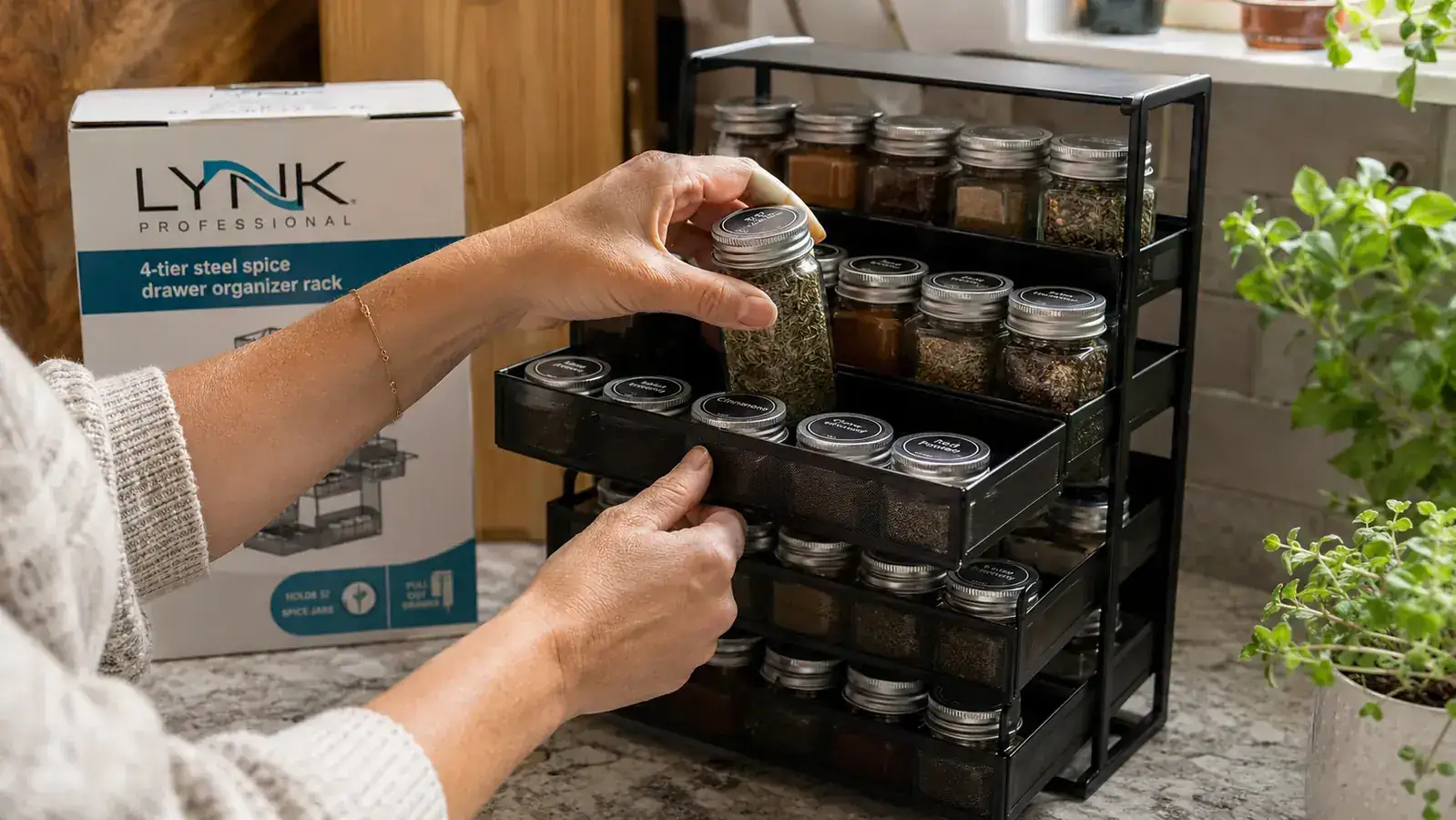
Setup is straightforward. The rack arrives flat-packed, and assembly takes about ten minutes with no tools. You unfold the wire tiers, clip the side rails into the notches, and set it into the drawer. There is no adhesive, no drilling. It sits by its own weight and the gentle pressure of being drawer-width. I always measure the drawer before ordering because the rack comes in three widths, and matching width to drawer is the single most important step. More on that under tradeoffs.
Once installed, the four tiers create a stair-step effect: shortest jars on the bottom front tier, tallest on the upper back tier. Every label faces up. You close the drawer and open it and every spice is readable at a glance, even the ones in the back row. For clients who cook daily, this alone is a genuine daily time-saver. Marcela told me at her 30-day check-in that she could not remember the last time she had dug for a spice.
What the Steel Build Actually Does in Practice
The most common question I get from clients when I pull out the LYNK PROFESSIONAL rack is: why steel? Glass spice jars are heavy, especially the 4-oz and 8-oz bottles that make up most spice collections. Over months of daily use, a lightweight acrylic insert deflects under that load. I have watched acrylic tiers develop a bow in the center, which means the jars in the middle row start tipping and the whole visual readability benefit falls apart. Heavy-gauge steel does not bow. After eight months across seven kitchens, not one LYNK rack had a bent or deflected tier.
The chrome finish also matters more than I expected. Two of my client kitchens have a habit of condensation near the dishwasher, and the drawers adjacent to the dishwasher get occasional moisture. In both cases the LYNK rack showed zero rust or finish degradation at the eight-month mark. The acrylic insert I had in one of those kitchens previously had developed a milky haze from moisture within three months.
The wire construction is also easy to clean. Spice dust and cooking oil settle into any organizer over time. With a solid acrylic surface you wipe a flat plane. With the LYNK steel wire you run a damp cloth between the tiers and lint from the cloth is the main annoyance. A can of compressed air takes care of the wire joints in about 30 seconds. For clients who actually clean their drawers (not all of them do, and I am not judging anyone), this is a genuine advantage.
After eight months in Marcela's drawer, the LYNK rack looks exactly the same as the day I installed it. I cannot say that about a single acrylic insert I have used.
Performance Over Time: The 30-Day, 90-Day, and 6-Month Check-Ins
At 30 days, every kitchen was reporting the same thing: cooking feels faster, nobody is hunting for spices, and the system had been maintained without any prompting from me. This is actually the key professional organizer metric. A system that falls apart two weeks after I leave the client's home is not a good system. The LYNK rack had a 100 percent maintenance rate at 30 days across all seven installs.
At 90 days the picture stayed positive, with one exception. In the Reinholt household with four kids under 10, the drawer was being opened and shut hard, multiple times a day, by small hands. The rack itself was fine. The problem was that the kids had rearranged the spices and the tier-height matching (short jars front, tall jars back) had gotten scrambled. This is a user behavior issue, not a product issue, but it is worth noting: if your household includes children who use the spice drawer independently, plan a 15-minute re-sort every few months. The rack will be exactly where you left it. The jars may not.
At six months, six of seven racks were unchanged from installation day. The seventh was in a kitchen where the homeowner had added a new set of spice jars that were wider than standard (the large Costco-style round jars, about 3 inches in diameter). Those did not fit neatly on the wire tiers, which are sized for standard cylindrical jars up to about 2.5 inches in diameter. We solved it by keeping the Costco jars in a separate section of the drawer alongside the rack. This is a known sizing quirk, not a defect.
Ingredient and Design Deep-Dive: What You Are Actually Buying
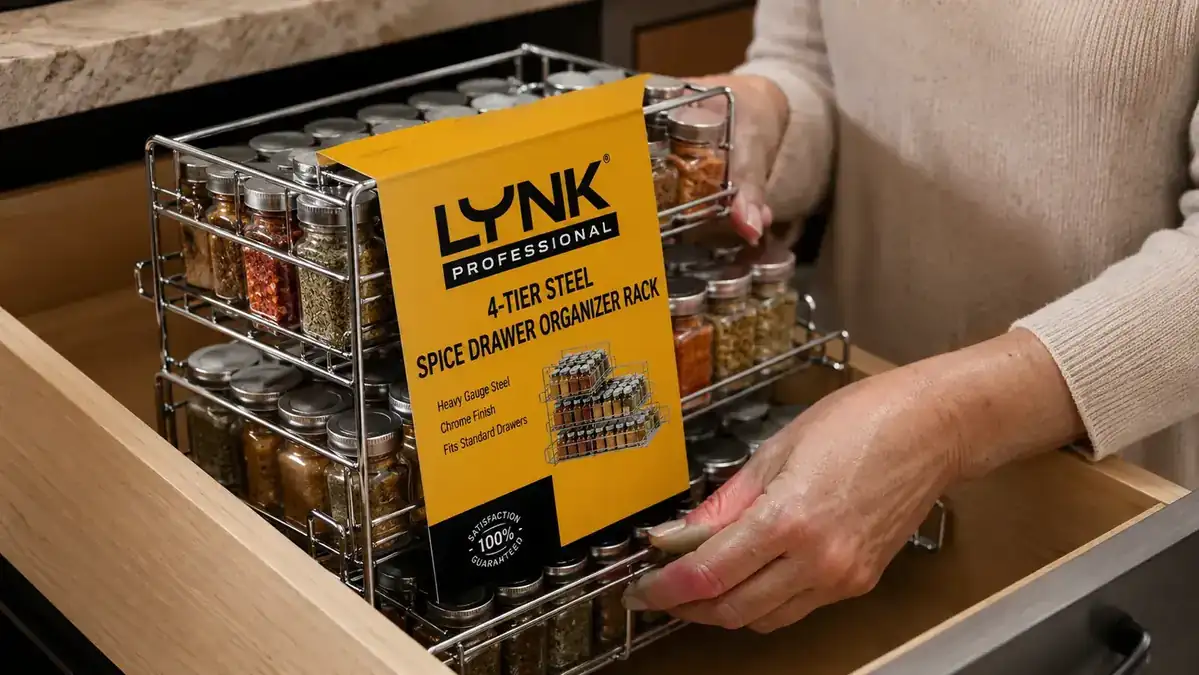
The LYNK PROFESSIONAL rack is heavy-gauge steel wire with a chrome plating. The tiers sit at four distinct heights: approximately 1.5 inches, 2.25 inches, 3 inches, and 3.75 inches from the drawer floor. This progression fits most standard spice jar heights, from small McCormick tins to tall glass bottles. The wire spacing on each tier is close enough to prevent jars from tipping but open enough for airflow. The rack is available in multiple widths, typically 14-inch and 21-inch, to match your drawer interior dimension.
The weight of the assembled rack is noticeable. Pick it up and you understand immediately that this is not a flimsy insert. That weight is also what keeps it from sliding around inside the drawer. I have not used adhesive or drawer-liner backing with any of the seven installs and none have shifted. Gravity and drawer width do the work.
LYNK PROFESSIONAL is a kitchen storage brand that focuses on drawer and cabinet organization, and this rack is one of their most reviewed products with over 8,000 customer reviews and a 4.7-star average. That rating tracks with my experience. The product does what it says on the listing, and it does it without any material compromise over eight months of real kitchen use.

Tradeoffs and Honest Limitations
The first and most important limitation is drawer depth. The rack needs a drawer at least 2.25 inches deep internally, measured from the drawer floor to the underside of the counter above it when the drawer is open. If your drawer is shallower than that, the top tier will not clear and the drawer will not close. I have measured this issue in three client kitchens over the past eight months. Two of those homes had older galley-kitchen drawers that were genuinely too shallow for this rack. In both cases I switched to a flat single-tier acrylic insert instead.
The second limitation is width sizing. The LYNK rack does not cut down to fit. You need a drawer that matches one of the available width options reasonably closely. A gap of half an inch on one side is fine and you can fill it with a folded piece of non-slip liner. A gap of 2 inches means the rack will shift and you will be sliding it back into position every week. Measure your drawer interior before ordering. I cannot say that more clearly.
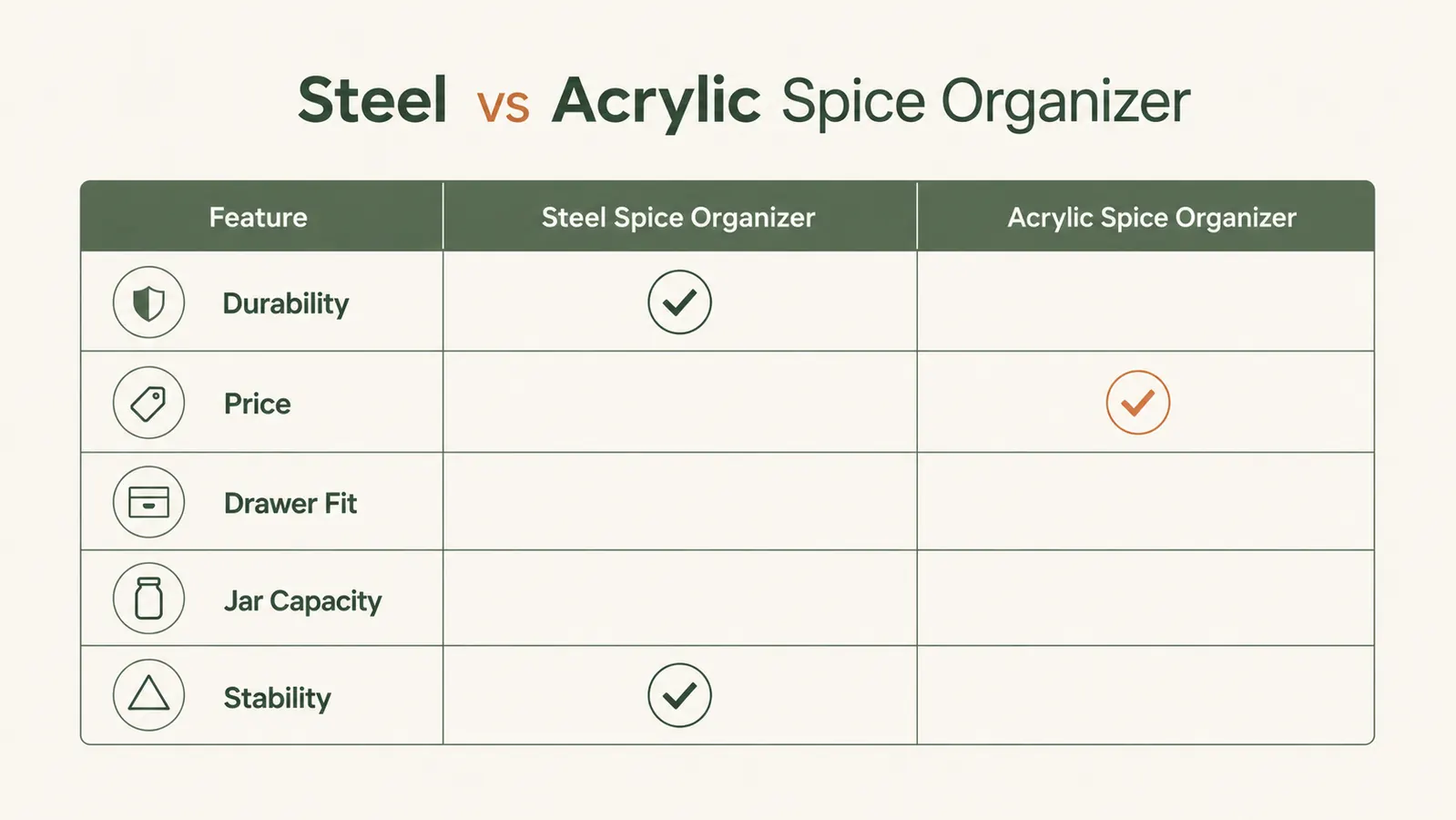
The third limitation is jar size compatibility. Standard spice jars, the ones from McCormick, Penzeys, Morton and Bassett, Spice Islands, and most grocery store house brands, fit perfectly. Extra-wide jars, oversized grinder bottles, and square spice tins do not sit as neatly on the wire tiers. If your collection is mostly non-standard shapes, a flat acrylic insert with adjustable dividers will serve you better. See my comparison of the LYNK against acrylic alternatives over at the LYNK vs acrylic spice organizer breakdown for a side-by-side look at which situations favor each.
What I Liked
- Heavy-gauge steel does not bow, crack, or deflect under the weight of glass jars
- Chrome finish resists moisture and shows no rust or degradation over months of use
- Four graduated tiers make every label visible at a glance without pulling jars out
- No adhesive or tools required for installation; removes completely without leaving residue
- Wire construction is easy to clean with a damp cloth or compressed air
- Sits stably by its own weight in a properly sized drawer without shifting
Where It Falls Short
- Requires a minimum drawer depth of approximately 2.25 inches internally; many older kitchens will not meet this
- Available in fixed widths only; gaps larger than an inch will cause shifting
- Wire tiers are not ideal for extra-wide, square, or non-standard spice jar shapes
- Steel is noticeably heavier than acrylic alternatives, which matters if you ever relocate it
- Higher price point than acrylic inserts; budget-forward buyers may find plastic acceptable for light use
Alternatives I Considered Before Installing the LYNK
Before I standardized on the LYNK rack for most spice drawer installs, I used three other solutions regularly. The most common was a flat single-tier acrylic insert with adjustable dividers. It works for shallower drawers and handles non-standard jar shapes better, but the acrylic cracks over time and the dividers can slip. I also tried a bamboo two-tier drawer insert from a kitchen goods brand that gets a lot of social media attention. It looks great in photos, holds up for about six months, and then the bamboo swells slightly from kitchen humidity and the tiers no longer sit level. The third option was a wire rack from a competing brand that used thinner gauge steel. The tiers bowed visibly within three months under a full load of glass jars. The LYNK rack uses heavier gauge steel than that competitor and it shows.
If you want a full breakdown of the LYNK against acrylic options with specific head-to-head scenarios, I cover that in detail in my LYNK vs acrylic spice organizer comparison. The short version: the LYNK wins on durability and stability for standard-sized spice jars in drawers that are deep enough. Acrylic wins on price and flexibility for non-standard jar shapes and shallow drawers.
Who This Is For
The LYNK PROFESSIONAL spice drawer organizer is the right choice if you cook regularly, have a drawer at least 2.25 inches deep, and want a spice system that will look the same two years from now as it does on day one. It is for the person who has bought two or three cheaper acrylic inserts and is tired of replacing them. It is for the client who has opened their spice drawer a thousand times and is done spending thirty seconds finding cinnamon. It is not for the occasional cook with twelve spices and a drawer that mostly holds other things. And it is not for anyone whose drawer dimensions do not match the available rack sizes. Measure first. If you match the requirements, this is the last spice drawer solution you will buy for years. If you want more reasons the right drawer organizer changes daily cooking, check out ten ways a spice drawer organizer saves real time every day you cook.
Who Should Skip It
Skip the LYNK rack if your drawer interior is shallower than 2.25 inches. This catches more kitchens than people expect, particularly galley kitchens in apartments, older ranch-style homes, and secondary kitchens. Also skip it if your spice collection skews toward wide-mouth jars, square tins, or large grinder bottles, those shapes will not sit neatly on the wire tiers and you will spend more time fussing than the system saves. If price is the primary concern and your spice jars are lightweight (mostly small plastic containers rather than glass), a flat acrylic insert at a lower price point will do an acceptable job for a year or two. The LYNK earns its price through longevity and daily stability, and if those factors matter less in your situation, the tradeoff is reasonable.
Eight months of daily kitchen use and not a single bent tier. Check if it fits your drawer before you order.
The LYNK PROFESSIONAL 4-tier steel spice drawer organizer is available on Amazon in multiple widths. Measure your drawer interior depth and width before ordering. If you match the requirements, this is the spice drawer fix that sticks.
Amazon Check Today's Price on Amazon →