
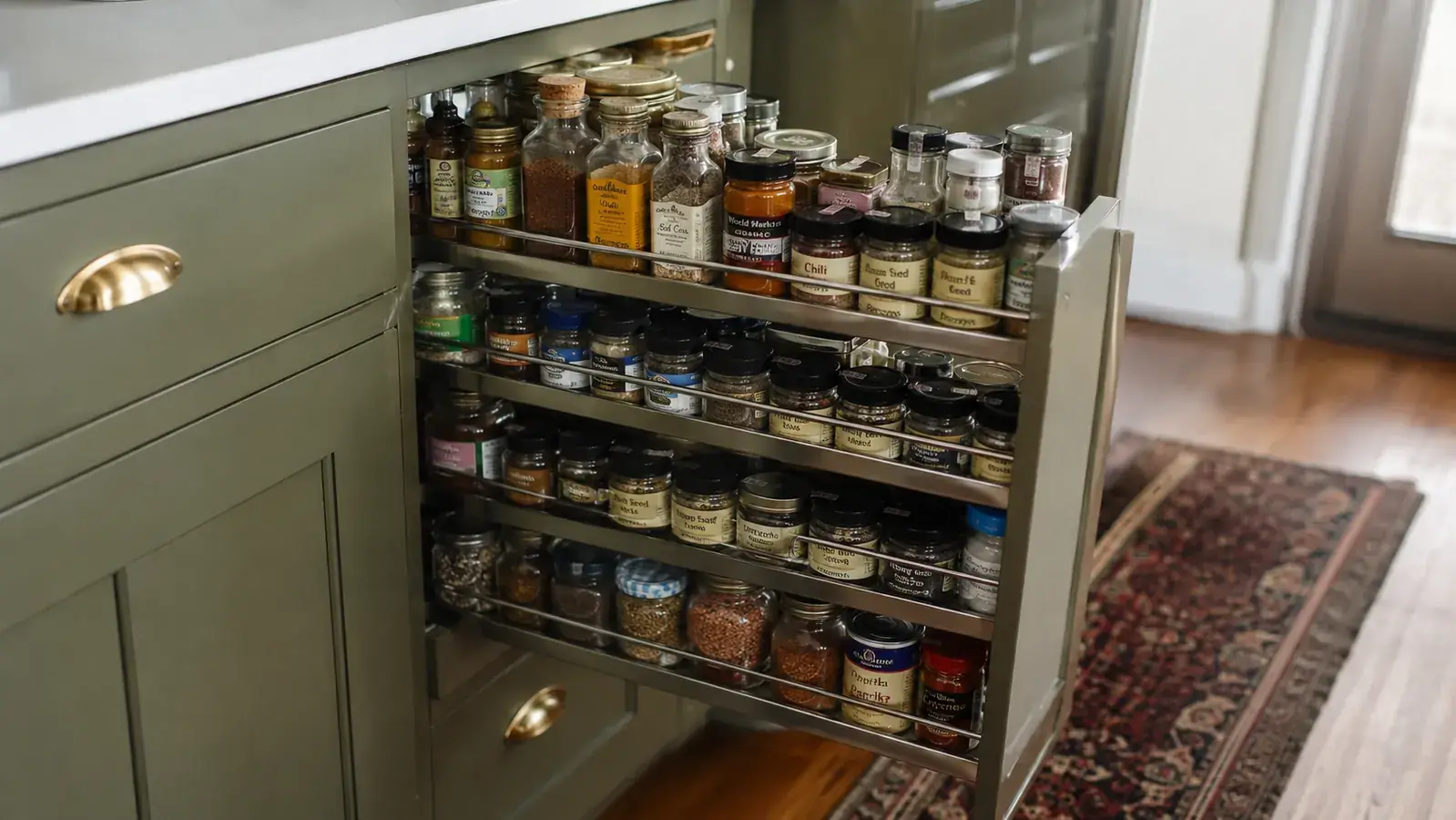
Let me start with the thing that sent three of my clients back to Amazon to initiate a return. Not because the LYNK PROFESSIONAL spice drawer organizer is a bad product. It is actually one of the better ones I have used in fifteen years of organizing kitchens. The returns happened because of a single number buried in the product description that most people do not notice until the rack is sitting in their kitchen: the minimum drawer depth required. If your drawer interior is shallower than about 2.25 inches, the tallest tier of this rack will not clear the underside of your counter when you try to close the drawer. I have watched three separate clients discover this live, and none of them had read that number before ordering.
That is what this review is actually about. The LYNK PROFESSIONAL 4-tier steel spice rack has over 8,000 reviews on Amazon and a 4.7-star rating, which is genuinely earned. But those thousands of happy buyers all had drawers that fit. The people who return it are a smaller, quieter group, and their reasons matter for anyone who is thinking about ordering without measuring first. I am going to walk through exactly what the product listing does not tell you clearly, who this works for without question, and who should put the tape measure away and look at something else.
The Quick Verdict
A well-built steel rack that deserves its high rating for kitchens where it fits, but drawer depth, jar width, and drawer size options are variables the listing undersells and buyers regularly overlook.
Amazon Check Today's Price →Measure your drawer depth before you click buy. If you clear 2.25 inches, this rack will outlast every plastic alternative you have tried.
The LYNK PROFESSIONAL 4-tier steel spice drawer organizer holds up to 36 standard spice jars at four readable heights. Check current availability and size options on Amazon.
Amazon Check Today's Price on Amazon →What the Product Photos Are Not Showing You
Amazon product photos for the LYNK rack are shot in a staging environment with perfect drawers. The drawer shown is deep, wide, and contains perfectly uniform cylindrical spice jars, all the same brand, all the same height. It looks exactly like the result you want. What it does not show you is the actual interior depth of that drawer, the gap between the top tier and the underside of the counter when the drawer is shut, or what happens when you try to put a different shape of jar on those wire tiers.
The wire tier spacing is designed for standard cylindrical spice jars in the 1.5-inch to 2.5-inch diameter range. Standard McCormick glass bottles, most grocery store house-brand jars, Penzeys tins in the round sizes, and similar containers drop right in and sit securely. What does not work as cleanly: the wider Kirkland spice jars from Costco (roughly 3 inches across), rectangular spice tins, square containers, or the large grinder-topped bottles with a wide base. Those shapes rest awkwardly on the wire tiers, either hanging over the edges or rocking slightly. The listing says the rack holds spice jars. It does. But not every shape of spice jar people actually own.
The second thing the photos hide is the weight of the rack itself before you load it. This is chrome-finished heavy-gauge steel, and it feels it. The rack empty is noticeably heavier than any acrylic drawer insert I have used. That weight is exactly why it does not bow or deflect under a full load of glass jars, but it is worth knowing before you handle it. If you are organizing a drawer in a rental and you want to be able to lift the whole thing out and carry it easily, plan for the extra heft.

The Drawer Depth Problem: Why People Return This
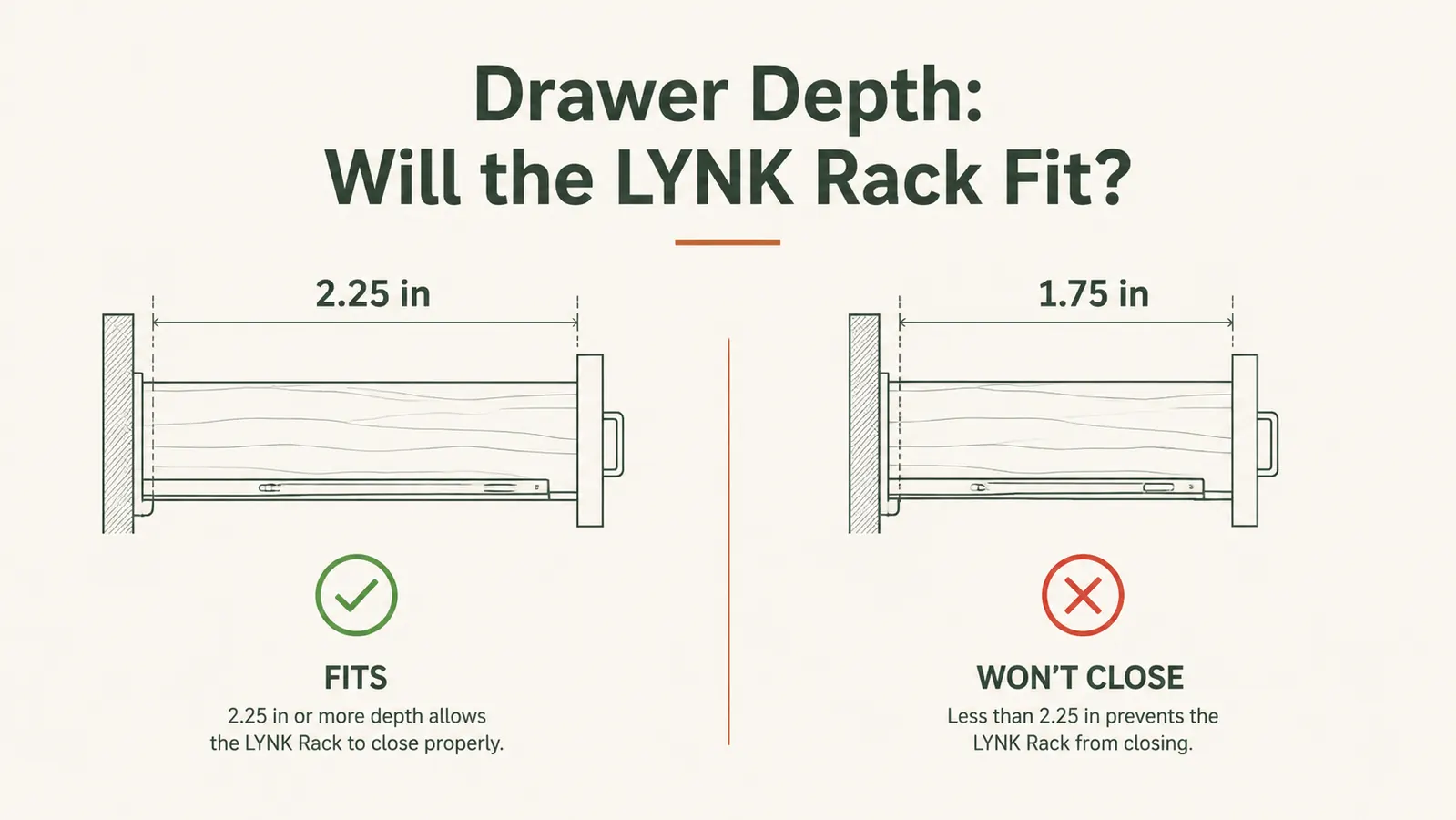
I want to be specific here because vague warnings do not help anyone. The clearance issue is this: when the rack is sitting in the drawer and the drawer is fully closed, the tallest rear tier needs enough vertical room between the drawer floor and the underside of the cabinetry above it. The product requires a drawer with an interior depth of at least approximately 2.25 inches, measured from the drawer bottom to the lowest point of whatever is above it when the drawer is shut.
Kitchens where this catches people off guard: older galley-style kitchens built in the 1970s and 1980s where the drawer clearances are sometimes 1.75 to 2 inches, not 2.25. Apartment kitchens with thin standard-issue cabinetry. Secondary or butler's pantry drawers that were built shallower to accommodate cabinet hardware above. And any kitchen where the drawer housing has extra framing material that reduces the actual open depth below what the cabinet looks like from the outside. You cannot tell just by looking. You need a ruler.
When the rack does not fit, the top tier catches on the counter underside when you try to close the drawer. Some buyers try to solve this by removing the tallest rear tier, which then defeats the whole 4-tier stair-step visibility system. A few reviews describe bending the rear tier down slightly to force clearance, which I would not recommend. The steel is heavy-gauge and does not bend easily, and forcing it risks damaging the frame. If your drawer is too shallow, the right move is a different product, not a workaround.
Drawer Width and Sizing: The Part That Surprises Buyers More Than It Should
The LYNK rack is available in a few fixed widths. The two most common are approximately 14 inches and 21 inches. These cover a wide range of standard kitchen drawers, but not every drawer. The fit expectation is that you choose the size closest to your interior drawer width, and a small gap of about a half inch on one side is fine and expected. What is not fine is a gap of 2 or 3 inches, where the rack shifts side to side each time the drawer opens or closes. Over time a shifting rack disrupts the neat row arrangement you installed it for.
Where I have seen people trip on this: they measure the outside of the drawer, not the inside. Cabinet drawers have interior dimensions that are smaller than the exterior opening because of the drawer box walls. A drawer that looks like it is 16 inches wide on the outside might have a 14.5-inch interior. If someone orders the 14-inch rack expecting it to be snug and then finds a 0.5-inch gap, that is fine and easy to fix with a piece of non-slip liner along the side. If they ordered the 21-inch version for what they thought was a wider drawer and find 2 inches of gap, that is a problem. Measure the interior.
The listing tells you the rack dimensions. It does not tell you to measure your drawer interior, not the exterior opening. That gap is where most of the return stories start.
What Buyer Reviews Reveal That the Star Rating Obscures
A 4.7-star average on over 8,000 reviews is a strong signal that the product delivers for the majority of buyers. But reading through the lower-rated reviews gives you a more useful map of exactly where this product fails. Three themes come up repeatedly in the one and two-star reviews, and none of them are product defects. They are compatibility mismatches.
The first is the drawer depth issue covered above. The second is jar size. Buyers who own a mix of standard and non-standard spice containers, including the large Kirkland jars, wide ceramic spice crocks, or tall rectangular Trader Joe's tins, report that only part of their collection works on the rack. The rest sits beside it in the drawer or gets relocated to a cabinet shelf. For a household with a fully standard-format spice collection, this is not a problem. For a household with a mixed collection built up over years, it is worth thinking through before ordering.
The third theme in low-rated reviews is the expectation that the rack would hold more jars than it does. The product description mentions capacity for a specific number of jars, but in practice the usable capacity depends on jar diameter. Narrow 1.5-inch jars pack in tightly and you can fit quite a few per tier. Wider 2.5-inch jars take up more wire real estate per row. Buyers who assumed they could relocate their entire 40-jar collection onto the rack and found it only held 28 of them at the right spacing sometimes felt short-changed, even though the product performed exactly as designed.

Where the Build Quality Earns Its Price
With all of that said, I want to be clear about what you get when the product does fit your kitchen. Heavy-gauge steel wire tiers that do not deflect under the weight of full glass jars. A chrome plating that handles kitchen humidity without rusting or developing the milky haze I have seen on acrylic inserts exposed to the same conditions. No adhesive needed, no tools, no permanent modification to the drawer. The rack simply sits by its own weight and the snug fit of a properly sized drawer.
The stair-step tier design genuinely delivers on readability. When the drawer is open, every jar label faces upward and every row is visible from front to back without pulling anything out. For a daily cook who reaches into the spice drawer five or six times while making dinner, this change in how long each grab takes is not trivial. The time savings accumulate. The alternative is a flat drawer with jars in loose rows where the back row requires actual excavation to access.
I have also found the wire construction easier to keep clean than solid plastic. Spice dust and oil vapor settle everywhere in a working kitchen. On a solid acrylic surface, this builds up as a film on the flat faces of each tier. On the wire construction, there is less surface area for buildup to stick to, and a damp cloth run along the wire clears most of it quickly. That matters in a real kitchen that gets used daily, not a staged one photographed once for a product listing. For a full guide on building a spice drawer system that holds up long-term, the step-by-step process for organizing spices in a kitchen drawer covers the full sequence including what to do before you install any rack.
What I Liked
- Steel build does not bow, crack, or deflect under daily use with heavy glass jars
- Chrome finish handles kitchen humidity without rusting or developing surface haze
- Four graduated tiers make every label readable at a glance without lifting jars
- No adhesive, no tools, no damage to drawer interior on installation or removal
- Wire surfaces are easier to wipe clean than solid acrylic in a working kitchen
- Sits stably without shifting in a properly sized drawer
Where It Falls Short
- Minimum drawer interior depth of about 2.25 inches required; shallower drawers will not close
- Available in fixed widths only; gaps larger than one inch will cause the rack to shift
- Wire tiers accommodate standard cylindrical jars well but are awkward with wide, square, or rectangular containers
- The rack is noticeably heavier than acrylic alternatives, which can matter for renters who move frequently
- Effective capacity depends on jar diameter; wide jars reduce how many fit per tier and may surprise buyers with large collections
The Honest Pre-Purchase Checklist
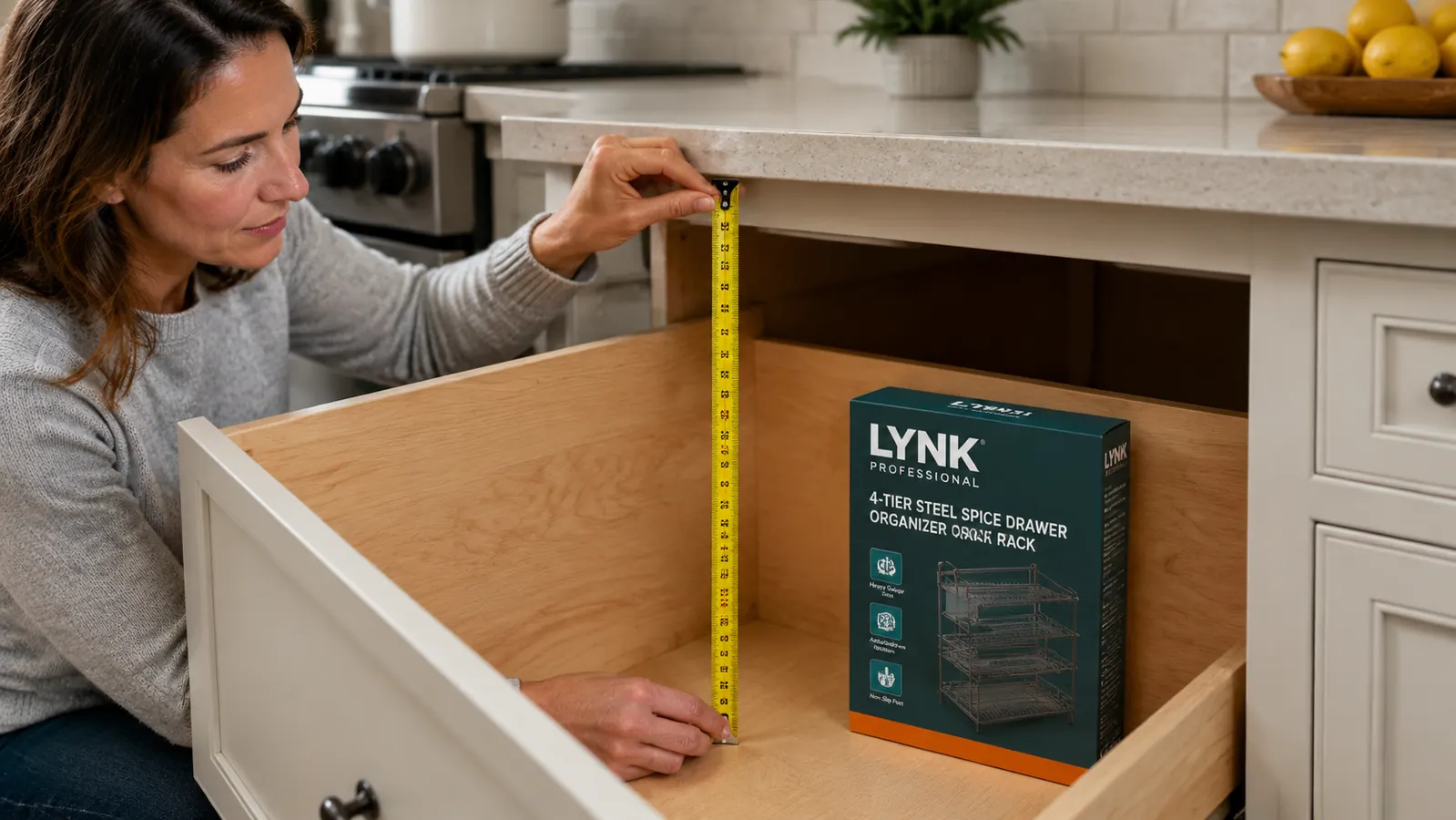
Before ordering, run through four checks. First: open the drawer you plan to use and measure the interior depth with a ruler. You need at least 2.25 inches between the drawer floor and the underside of the cabinet above it when the drawer is closed. Second: measure the interior width of the drawer box, not the width of the drawer opening. Pick the rack width that is closest to that measurement without exceeding it. Third: look at your spice jar collection and estimate what percentage of the jars are standard cylindrical containers between 1.5 and 2.5 inches in diameter. If that number is below about 70 percent, you may find yourself running two storage systems side by side. Fourth: count your jars. Standard collections of 20 to 30 jars work extremely well with this rack. Collections of 45 or more jars may need two racks or a supplemental shelf elsewhere.
If all four of those checks pass, the LYNK PROFESSIONAL rack is a straightforward, durable choice. The build quality at this price point is hard to match. What I appreciate professionally about it is that there is nothing to maintain and nothing to replace. Unlike a bamboo insert that swells from humidity, or a plastic insert that cracks from the weight and daily impact of opening and closing, the steel just stays exactly as you placed it. That is actually what a good organizing product should do: disappear into your routine and stop requiring attention.
Who This Is For
This rack is the right call for anyone who cooks regularly, owns a mostly standard spice jar collection, and has a kitchen drawer that passes the four checks above. It is especially well-suited for people who have already tried cheaper acrylic or bamboo inserts and found them cracking, warping, or bowing within a year. The steel build is noticeably more robust than those alternatives and the difference becomes obvious the first time you load the rack with a full complement of glass jars. If you are setting up a kitchen for the first time and want a spice system you will not need to replace, the LYNK rack is a good foundation to build around. For more on how this product fits into a broader kitchen drawer approach, the LYNK vs acrylic spice organizer comparison gives you a direct side-by-side look at which format fits which kitchen.
Who Should Skip It
Skip the LYNK rack if your drawer depth measures under 2.25 inches. This is the single most common reason for returns and it is non-negotiable. Also skip it if your spice collection leans heavily toward wide-mouth jars, square tins, tall grinder bottles, or oversized bulk containers. Those shapes will sit awkwardly on the wire tiers and you will spend more time fussing than organizing. If your kitchen drawer is a non-standard width that falls between the available rack sizes with more than an inch of gap, look at adjustable acrylic dividers that can be trimmed to fit instead. And if you rent and move frequently, the weight of the rack is worth factoring in. It is not a reason not to buy it, but it is real. The right product is the one that fits your specific kitchen, not the one with the most stars.
Pass the four-check test? Then this is the last spice drawer solution you will buy for years.
Measure drawer depth and interior width first. If you clear 2.25 inches of depth and your drawer matches one of the available widths, the LYNK PROFESSIONAL steel rack is the most durable spice drawer organizer at this price. Check current availability on Amazon.
Amazon Check Today's Price on Amazon →